What Is Practice Management Software?
What it does, why local practices are switching, and how to choose
From a team that has built medical practice software since 1985
Medical Practice Management Software in South Africa
Ask almost any practice manager in South Africa what swallows their week, and very few will say patient care. It is the admin around the care. The chasing of unpaid claims, the double bookings, the lost files, the month-end scramble to work out whether the practice actually made money. Medical practice management software exists to take that load off your plate.
The trouble is that the term covers a lot of ground, and the advice online is often written for American or European practices that never have to think about a local medical scheme or a SARS deadline. This guide is written for the South African reality. It explains what practice management software does, why so many local practices have already made the switch, and how to choose a system that genuinely fits the way you work.
It is also the area we have spent nearly four decades in. GoodX has built software for South African practices since 1985, so where it helps to make things concrete, we use our own platform as the worked example. Think of this page as your map: each section gives you the essentials, and where there is more worth knowing, we point you to a deeper resource. By the end you should know exactly what to look for and what questions to ask before you commit to anything.
What This Guide Covers
- What is medical practice management software?
- Why South African practices are going digital
- The core parts of a practice management system
- Medical billing and claims management
- Electronic records and all-in-one workflows
- Improving patient experience and practice growth
- Specialised care and emerging technology
- Data security, POPIA, and compliance
- Training, support, and getting started
- Understanding the investment and the return
- How to choose the right software for your practice
- Frequently asked questions
What Is Medical Practice Management Software?
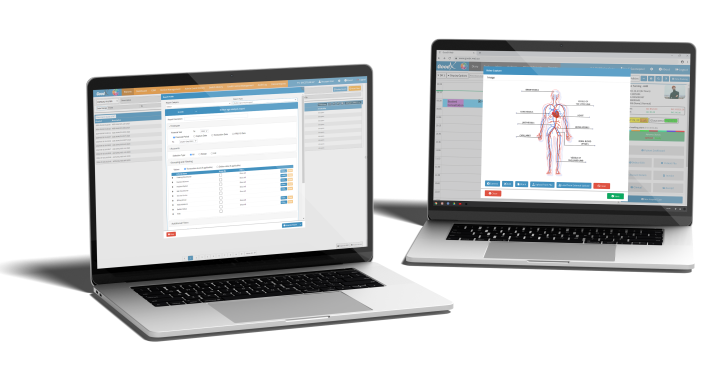
Medical practice management software is a single digital system that runs the daily operations of a healthcare practice. Rather than stitching together a diary here, a billing tool there, and a pile of paper files in the corner, everything lives in one connected platform that the whole team can use at the same time.
In plain terms, it looks after your appointment book, stores patient and account details, submits claims to medical schemes, follows up on payments, and keeps a secure clinical record for each person you treat. When those pieces talk to each other, the work stops falling through the cracks. A booking becomes a consultation, the consultation becomes an accurate claim, and the claim becomes money in the bank, all without anyone retyping the same information three times.
Most modern platforms, GoodX included, are cloud based. That means your information is available securely whether you are in your rooms, at the hospital, or catching up on notes at home. For a profession that rarely sits still, that kind of access has gone from a nice extra to something practitioners simply expect.
It helps to separate two terms you will see often. Practice management generally refers to the business side, scheduling, billing, and accounts. Electronic health records refer to the clinical side, your notes, results, and history. The best systems combine both, which is exactly why they save so much time, and it is the approach GoodX has taken from the start.

Why South African Practices Are Going Digital
The move away from paper is being pushed by three forces at once. Patients expect more, the admin burden keeps climbing, and the regulatory direction of travel is clearly digital. The World Health Organization counts health information systems among the six core building blocks of a functioning health system, and its Global Strategy on Digital Health frames digital tools as central to strengthening them. That thinking has worked its way down to the level of the everyday practice.
Record keeping is not a matter of preference. The Health Professions Council of South Africa sets out clear standards for how patient records must be created, kept, and protected. Meeting those standards with a filing cabinet is slow and risky. Meeting them with software that timestamps every entry and backs itself up automatically is far simpler, and it stands up better if your records are ever questioned.
There is also the wider national picture. The National Department of Health continues to push for better coordinated, more digital healthcare across the country, a direction set out in its National Digital Health Strategy and reinforced by the groundwork for National Health Insurance. Practices that have already modernised will find it much easier to connect with that direction than those still buried in paper.
And then there is the simple business case. Time spent on admin is time not spent seeing patients or building the practice. Every manual step you remove is a small recovery of the thing you can never make more of, which is time.
The Core Parts of a Practice Management System
It is easier to judge a system once you know what the main pieces are meant to do. While platforms differ in polish, most serious practice management software is built around a handful of core areas that work together.
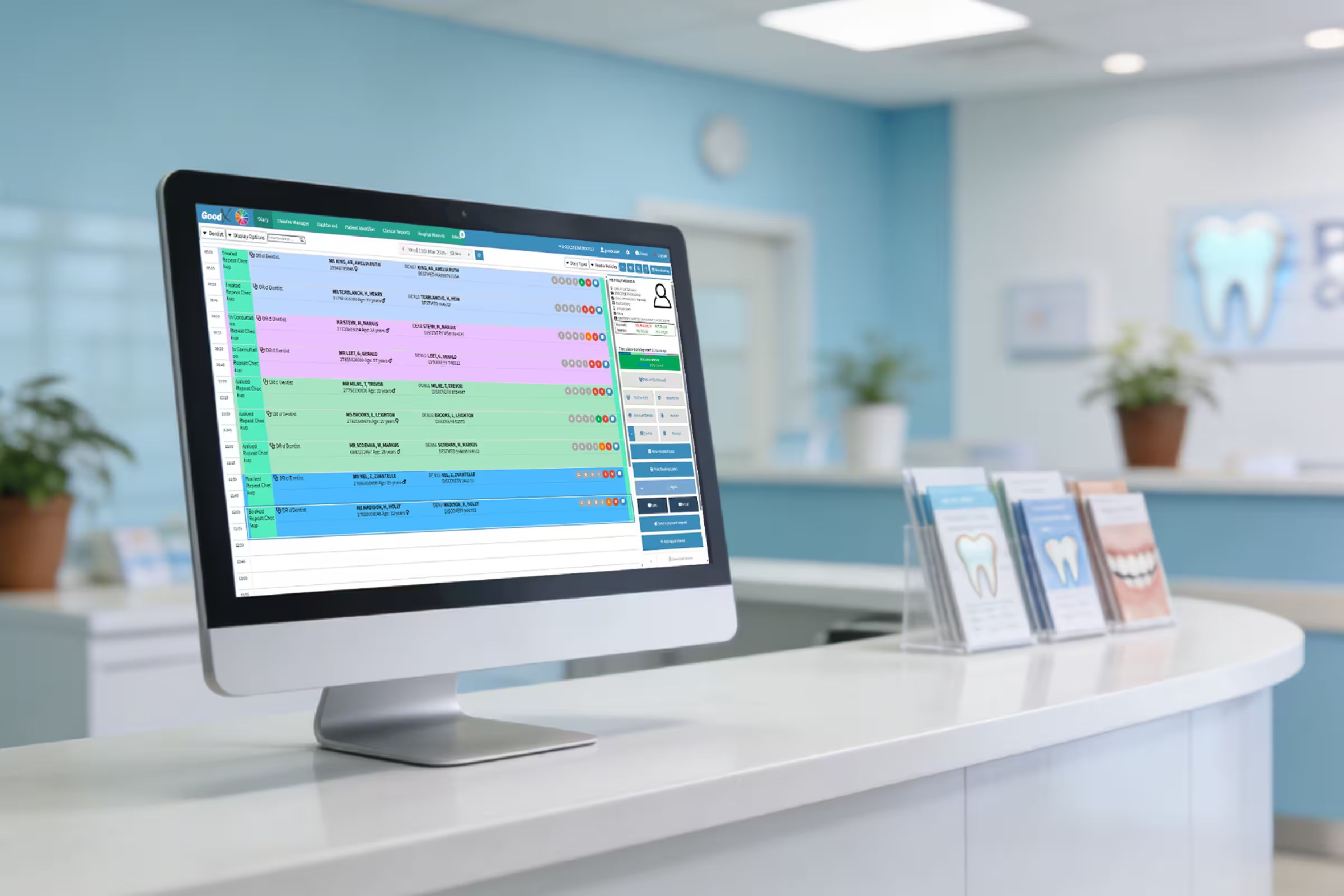
Scheduling and diary management sit at the front of everything. A good diary handles multiple practitioners and rooms, sends automated reminders to cut no-shows, and lets reception see the whole day at a glance. When the diary is smart, the waiting room is calmer.
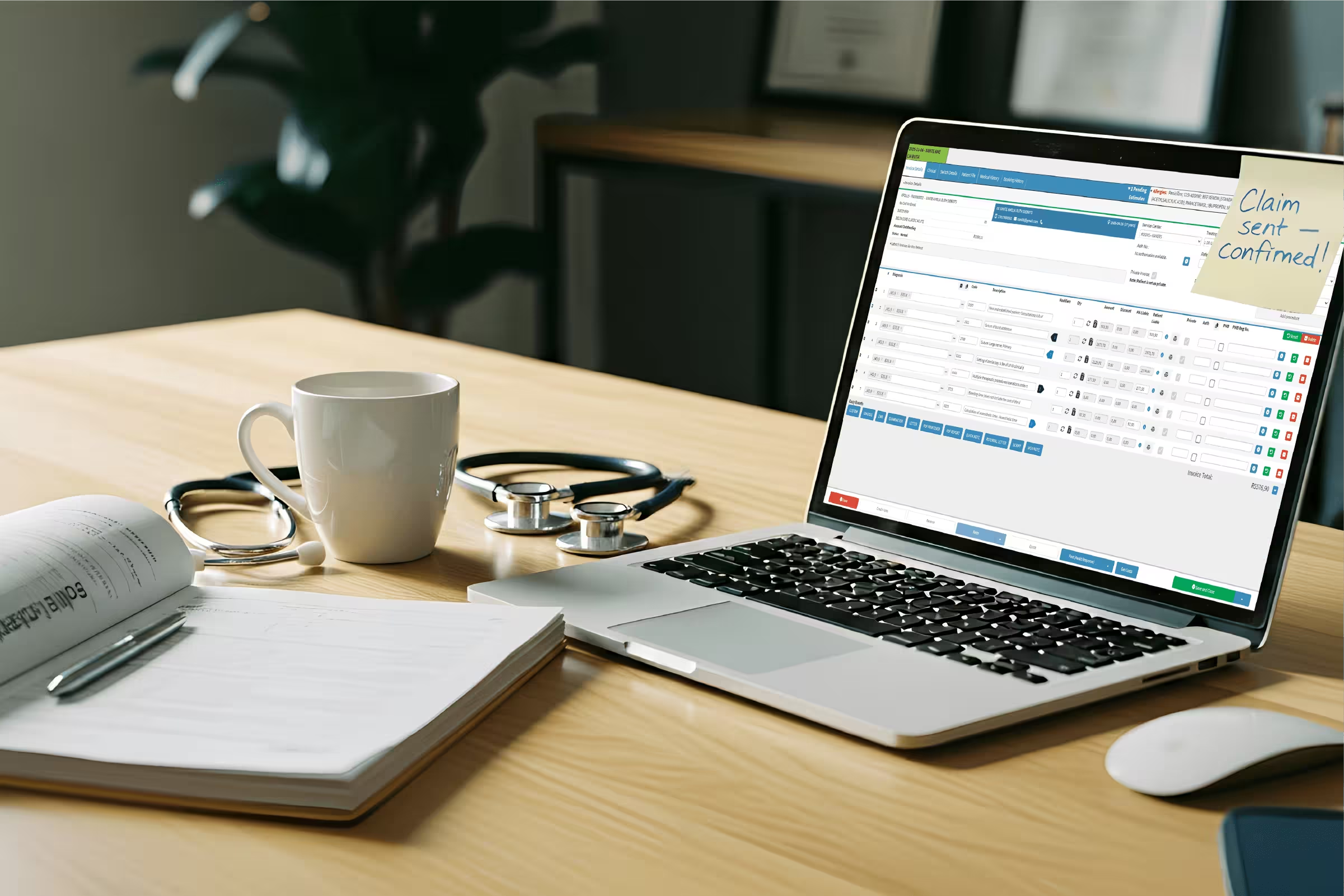
Billing and claims is where the financial health of the practice is won or lost. This is the engine that prepares claims, sends them to the right scheme, and tracks what comes back. Done well, it shortens the gap between treating a patient and being paid for it.
Clinical records hold the medical story of each patient, from consultation notes and prescriptions to results and referral letters. Because this lives in the same system as billing, a finished note can feed straight into an accurate account with nothing lost in translation.
Reporting ties it all together. Clear dashboards show you which schemes pay slowly, where claims get rejected, and how the practice is tracking month to month. You cannot fix what you cannot see, and good reporting finally lets you see it.
GoodX brings these four areas, the diary, billing and claims, clinical records, and reporting, into a single platform, so they all draw on the same patient and account information rather than four disconnected tools that never quite agree with one another.
Medical Billing and Claims Management for South African Practices
For most practices, billing is where the quiet money leaks happen. Rejected claims, slow remittances, and hours lost to manual reconciliation can drain an otherwise healthy practice without anyone quite noticing. The right tools reverse that by submitting cleaner claims and giving you a clear line of sight over every cent owed to you.
Choosing who to trust with this part of the business is a big decision, so it is worth doing your homework. Our overview of the top medical billing companies in South Africa is a sensible starting point, and our breakdown of the best medical manager billing software for 2026 looks at what the latest generation of tools can actually do for you.
Medical aid integration deserves a closer look in the local market, because this is where so many international systems fall short. It is also where GoodX has concentrated, with medical aid submission and remittance tracking built in for the South African schemes. We cover the top medical aid billing software for South African practices and explain how online medical billing software can simplify claims and protect your cash flow.
The pattern we see again and again is simple. When billing is tidy, the whole practice breathes easier. Getting this one area right is often the fastest, least painful way to improve a practice’s finances, usually faster than trying to see more patients.
Electronic Records and All-in-One Workflows
Billing works best when it is not treated as a bolt-on. When your clinical records and your accounts share the same system, a completed consultation can flow straight into an accurate claim without a single field being retyped. That shared foundation is the real promise of an all-in-one platform, and it is the principle GoodX was designed around: the clinical record and the account are two views of the same data, not two systems trying to stay in sync.
If electronic records still feel like unfamiliar territory, start with our complete guide to EHR software for South African practices, which explains the fundamentals without the jargon. From there, see how you can simplify your workflow with all-in-one EMR and medical billing software so that clinical care and the business side finally pull in the same direction.
The difference shows up in the small moments. A script written during a consult is instantly on file. A result lands against the right patient. A claim reflects exactly what was done, because it was built from the note itself. None of this is dramatic on its own, but across a busy week it adds up to hours returned and far fewer mistakes.
Improving Patient Experience and Practice Growth
Patients judge your practice on a lot more than the clinical outcome. Easy booking, short waits, clear communication, and a painless payment all shape whether they come back and whether they tell a friend. Practice management software touches every one of those moments, often without the patient ever realising it.
Small operational wins stack up into a noticeably better experience. Automated reminders mean fewer missed appointments. Faster check-in means a shorter queue. Accurate accounts mean fewer awkward billing conversations at the front desk. Each one removes a little friction, and friction is what quietly drives patients away.
Our look at the GoodX features that improve patient satisfaction shows how the right tools make the experience smoother for patients and staff alike. That smoothness is where loyalty is built, and loyal patients are the most affordable growth a practice will ever find.

Specialised Care and Emerging Technology
No two disciplines work in quite the same way, and the better systems flex to match a field rather than forcing every practice into one rigid mould. Specialists in particular benefit from tools shaped around how their work actually flows, from the equipment they use to the way they code and bill. GoodX, for that reason, is configured differently for fields ranging from general practice and dental to ophthalmology, radiology, and hospital groups.
Ophthalmology is a good example of a field being reshaped by new technology. Imaging, diagnostics, and data are changing what is possible in the consulting room, and the software behind the scenes has to keep pace. Our piece on emerging technologies in ophthalmology looks at where specialist care is heading and how practice software supports more advanced, data driven treatment without piling on extra admin.
The lesson applies well beyond eye care. Whatever your speciality, a system that understands your specific workflow will always serve you better than a generic one you have to fight against every day.
Data Security, POPIA, and Compliance
Patient information is among the most sensitive data any business can hold, and protecting it is both an ethical duty and a legal one. Under the Protection of Personal Information Act (POPIA) your practice is the responsible party in law, which means you are legally accountable for keeping patient data secure and using it only for the purposes for which it was collected. Serious breaches can carry administrative fines of up to R10 million and, in the most serious cases, imprisonment of up to 10 years, and the damage to patient trust can be just as costly. POPIA’s 2026 regulations on the processing of health information go further still, setting specific expectations for the confidentiality, integrity, availability, and safe disposal of health records.
Purpose built practice management software takes much of this weight off you. Controlled access means staff only see what their role requires. Encryption protects information in transit and at rest. Because GoodX is cloud hosted, your data is backed up and recoverable, rather than sitting on a single office computer that could be stolen or fail overnight.
Compliance is not only about data privacy, though. Accurate, well kept records also help you meet the professional standards expected by the HPCSA and the rules that govern your dealings with medical schemes. A good system makes doing the right thing the path of least resistance, which is exactly how it should be.
Training, Support, and Getting Started
Even the best software only pays off when your team feels confident using it. A short, structured onboarding is what separates a system that is merely installed from one that is genuinely woven into how the practice runs each day. Skipping that step is the most common reason good software underdelivers.
To build that confidence quickly, the GoodX online short course walks new users through the essentials at their own pace. It is a practical, low pressure way to get a whole practice comfortable before going live, so the switch feels like a step forward rather than a leap into the unknown.
Ongoing support matters just as much as the first week. Software is not a once-off purchase. Schemes change their rules, your practice grows, and new staff arrive. A provider who keeps the system current and answers the phone when you need them turns a tool you tolerate into one you genuinely rely on, which is the standard we hold ourselves to at GoodX.

Understanding the Investment and the Return
It is natural to weigh up the cost of new software, but the more useful question is what it gives back. The real return shows up as time recovered, claims paid faster, and fewer costly errors, rather than as a single line on an invoice.
Picture the hours your team currently spends rekeying data, chasing rejected claims, and reconciling accounts by hand. Now imagine most of that handled automatically. That recovered time can go back into seeing patients or simply into a less stressful working day, and both have a value that is easy to underestimate.
There is a protective side too. Cleaner claims mean fewer rejections and less revenue quietly slipping away. Better reporting means you spot a slow paying scheme or a billing pattern long before it dents your cash flow. Viewed that way, the right system tends to pay for itself rather than simply costing money.

How to Choose the Right Practice Management Software
Start with the problems you most want to solve. If claims are your headache, weight your decision towards strong medical aid integration and clear reporting. If your records are a mess, put the clinical system first. The point is to choose for your own reality, not for the longest feature list on a brochure.
Local fit matters enormously. Your software should understand South African medical schemes, support local coding standards, and help you work within the regulatory framework overseen by bodies such as the Council for Medical Schemes, which regulates the schemes your claims are submitted to under the Medical Schemes Act. International platforms that ignore these realities tend to create more work than they save, no matter how slick they look in a demo. This is the gap a locally built system like GoodX is designed to close.
Look hard at what happens after the sale, because that is where many tools quietly fail. Reliable support, regular updates, and proper training are what keep a system useful for years rather than months. Ask any provider exactly what their support looks like in week one and in year three.
Frequently Asked Questions
What does medical practice management software do?
Medical practice management software runs the daily operations of a practice in one connected system. It manages appointments, patient details, clinical records, medical aid claims, and payments. By replacing separate manual tools, it reduces errors, saves administrative time, and gives practitioners a clear view of how the practice is performing.
Is medical practice management software suitable for small practices?
Yes. Small and solo practices often benefit the most, because a few staff usually carry the full administrative load. Cloud based practice management software automates billing and records, cuts down on paperwork, and scales as you grow, making professional systems realistic for practices of any size in South Africa.
How does practice management software help with medical aid claims?
Good software submits claims to medical schemes directly, checks them for common errors before sending, and tracks remittances automatically. This means fewer rejections, faster payments, and healthier cash flow. For South African practices, strong medical aid integration is one of the most valuable features a system can offer.
Is medical practice management software secure and POPIA compliant?
Reputable platforms are built with security and compliance at their core. They protect patient information through controlled access, encryption, and secure cloud hosting, helping practices meet their obligations under the Protection of Personal Information Act and the record keeping standards set by the HPCSA.
Can practice management software work for specialists?
Yes. The best systems adapt to the workflow of a specific discipline rather than forcing a one size fits all approach. Specialists such as ophthalmologists benefit from tools that match their coding, equipment, and consultation flow, which keeps both clinical work and billing accurate and efficient.
How long does it take to start using practice management software?
Timelines depend on the size of your practice and how much existing data needs to move across. A solo practice can often be operational within days, while larger groups may take a few weeks. Structured training and onboarding support help your team get comfortable quickly and confidently.
Book Your Free GoodX Demo
Ready to see what a single, connected system could do for your practice? GoodX is built specifically for South African practitioners, bringing your scheduling, billing, medical aid claims, and clinical records together in one secure platform that your whole team can rely on.
See it in action for yourself and book your free GoodX demo. Our team will walk you through exactly how GoodX fits the way your practice already works, with no pressure and no obligation.